People-Pleasing and CBT: How to Set Boundaries Without Guilt
Saying “yes” when you want to say “no”. Avoiding conflict, even when something feels off. Prioritizing other people’s needs at the expense of your own.
People-pleasing is often talked about as a personality trait, but it usually runs much deeper than that. For many, it is a learned pattern rooted in a need for safety, approval, or connection.
While it may help maintain harmony in the moment, over time it can lead to emotional exhaustion, resentment, and a disconnection from your own needs.
Why People Pleasing Develops
People-pleasing does not come out of nowhere. It often begins as an adaptive response.
In environments where approval felt conditional or conflict felt unsafe, being agreeable and accommodating can become a way to protect yourself. Over time, this response becomes automatic. Even when circumstances change, the pattern can stay in place.
What once helped you navigate relationships can start to work against you.
You might notice:
Difficulty saying “no” without guilt
A strong fear of disappointing others
Overthinking how you are perceived
Agreeing to things you do not have the capacity for
Feeling responsible for other people’s emotions
These patterns are not a reflection of weakness. They are learned behaviours that can be understood and reshaped.
The Cost of Always Saying “Yes”
People-pleasing often creates a gap between what you genuinely want and what you feel you should do.
In the short term, saying “yes” may reduce discomfort. It can avoid tension or keep others happy. Over time, the cost becomes clearer.
This can look like:
Emotional burnout
Growing resentment in relationships
Loss of personal time and energy
Feeling disconnected from your own values
When your needs are consistently set aside, it becomes harder to feel grounded and fulfilled in your day-to-day life.
How Cognitive Behavioural Therapy Helps
In the context of people-pleasing, CBT focuses on the beliefs that drive the behaviour.
Common underlying thoughts might include:
“If I say no, they will be upset with me”
“I have to keep everyone happy”
“My needs are less important than other people’s”
These thoughts can feel immediate and true, but they are often shaped by past experiences rather than present reality.
CBT helps slow this process down. Instead of automatically reacting, you begin to question the thought and consider alternative perspectives.
Questions That Create Awareness
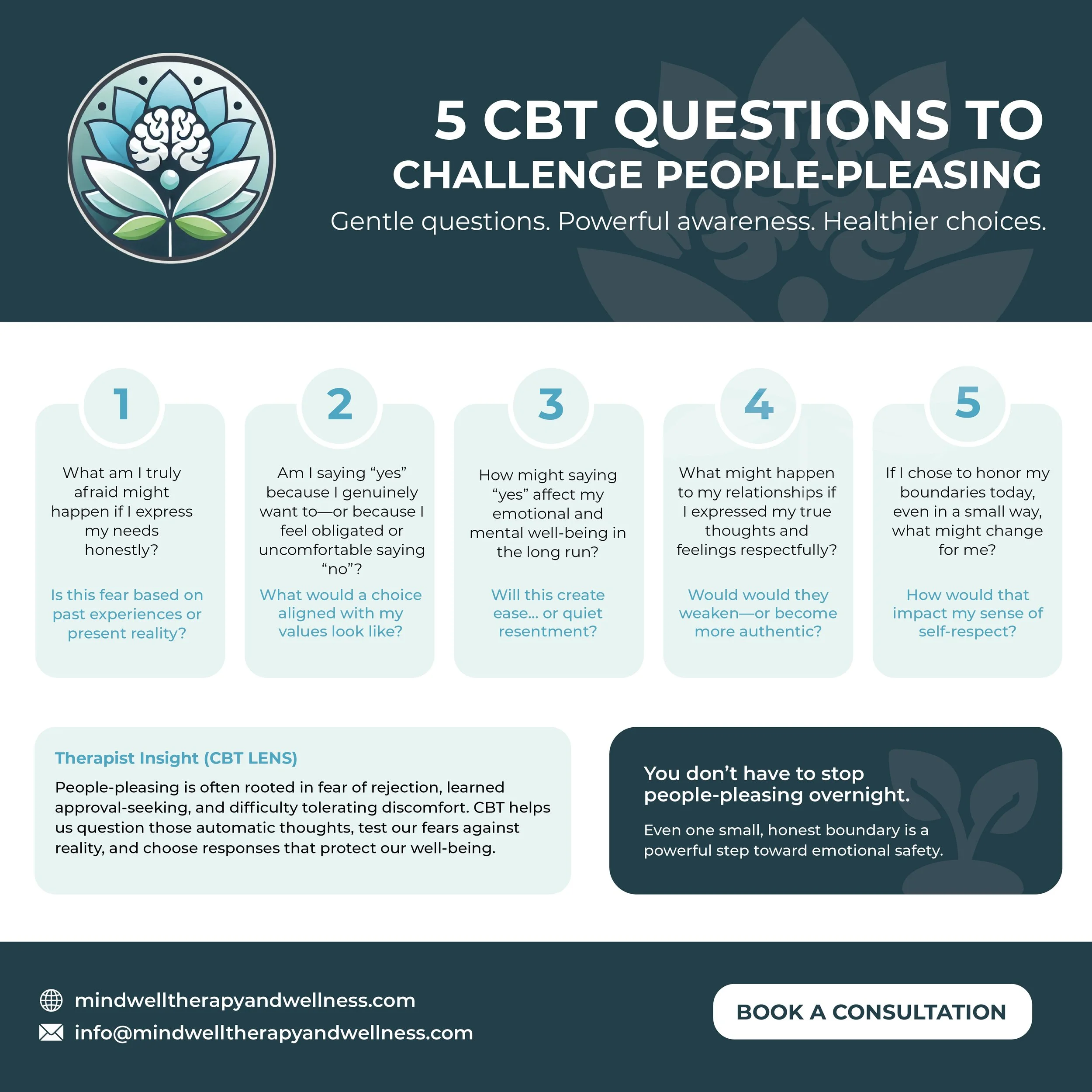
A key part of CBT is learning to challenge automatic thoughts with more balanced reflection.
Some helpful questions include:
What am I truly afraid might happen if I express my needs honestly?
Am I saying yes because I want to, or because I feel obligated?
How will this decision affect me later, not just right now?
Is this fear based on my current situation, or something I have experienced before?
What would it look like to honour my boundaries in a small way today?
These questions are not about forcing change. They are about creating space between the impulse to please and the ability to choose.
Boundaries as a Form of Self-Respect
Boundaries are often misunderstood as something that pushes people away. In reality, they are what allow relationships to feel clear, respectful, and sustainable.
When you communicate your needs honestly, you give others the opportunity to understand you more accurately. This often strengthens connection rather than damaging it.
Setting boundaries can start small:
Taking time before agreeing to a request
Saying “I can’t commit to that right now”
Expressing a preference, even if it feels uncomfortable
These moments build over time. Each time you act in alignment with your needs, you reinforce the belief that your voice matters.
Moving From Automatic to Intentional
People-pleasing tends to happen quickly. The response is often immediate, without much conscious thought.
The goal is not perfection. It is awareness.
Even a brief pause can begin to shift the pattern. Noticing the urge to say “yes”, checking in with yourself, and choosing your response with intention can gradually create change.
Over time, the internal narrative starts to shift. Instead of feeling like you must keep everyone happy, there is more room to consider what is actually healthy and sustainable for you.
When Support Can Make a Difference
Changing long-standing patterns can be challenging to do alone. Therapy offers a space to explore where these behaviours come from and how they are showing up in your current life.
Working with a therapist using Cognitive Behavioural Therapy can help you:
Identify the thoughts driving people pleasing
Reduce anxiety around setting boundaries
Build confidence in expressing your needs
Strengthen your sense of self in relationships
This process is not about becoming less caring. It is about learning how to care for others without losing yourself in the process.
A Different Way to Think About People-Pleasing
Instead of asking “Why do I keep doing this?”, it can be more helpful to ask “What is this pattern trying to protect me from?”
When you understand the purpose behind the behaviour, it becomes easier to approach change with compassion rather than criticism.
You are allowed to take up space in your relationships. Your needs, limits, and preferences are valid.
Learning to express them is not selfish. It is a step toward healthier, more balanced connections.